
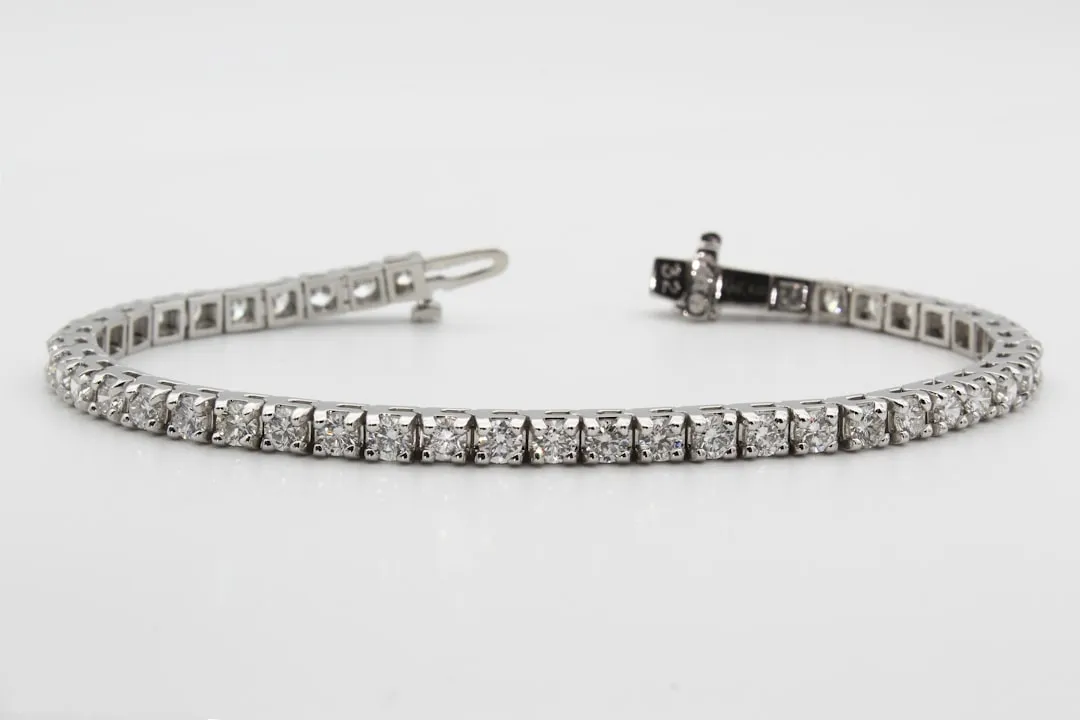
This tennis bracelet buying guide is how I help you nail the three things that matter most before you fall in love with the sparkle: carat weight, length, and clasp security. I’m Zak, founder of Quantum Qarat here in Phoenix, and I’ve sized, rebuilt, and custom-made enough tennis bracelets to know where buyers get tripped up. The good news is you don’t need a gemology degree. You just need a couple of smart checkpoints and a clear idea of how you’ll actually wear it.
A tennis bracelet is one of those pieces that doesn’t ask for an occasion. You can wear it with a tee, a blazer, or next to your wedding set, and it still looks intentional. And if it’s built right, it’s also a “keep it forever” kind of bracelet: you can service it, adjust it, tighten stones, swap clasps, and keep it looking crisp for decades.
What you’re really buying with a tennis bracelet
At its core, a tennis bracelet is a flexible line of diamonds or gemstones that sits close to the wrist and moves with you. The name comes from the moment it became famous, when a player’s line bracelet came undone mid-match and the style suddenly had a story people remembered. If you want the quick background, Brilliant Earth’s overview of the tennis bracelet sums up how it got its name and why it stuck.
When you’re choosing one today, the vibe is the same: clean, symmetrical sparkle, comfortable to wear, and easy to stack. The only catch is that a bracelet is more “mechanical” than most jewelry. It bends, it flexes, it gets tugged by sleeves and bags. That’s why I’m going to keep bringing you back to the big three: carat, length, and clasp.
Tennis bracelet buying guide: total carat weight (CTTW) without the confusion
Let’s clear up the most common mix-up I hear: tennis bracelet carat weight usually means total carat weight, also called CTTW. That’s the combined weight of all the diamonds in the bracelet, not the size of one diamond.
As CTTW climbs, you generally get bigger individual stones and more visual presence across the wrist. It also changes how it feels when you wear it. A lighter bracelet can disappear into your daily routine. A heavier one has that “you know it’s there” presence, in a good way, as long as the clasp and build quality match the weight.
| Total Carat Weight (CTTW) | How it usually reads on the wrist | Who it tends to suit |
|---|---|---|
| 1 to 2 ct | Fine line of sparkle, subtle from a distance | Minimalists, layering, petite wrists |
| 3 to 5 ct | Noticeable and balanced, still easy to wear | Most buyers, everyday luxury |
| 5 to 7 ct | Bold, you’ll see it in photos and across a table | Milestones, dressier wardrobes |
| 7 to 10+ ct | Big brilliance, definitely statement territory | Anniversaries, glam stacks, collector pieces |
Tennis bracelet buying guide: picking the right carat range for your style
I don’t hand people a rulebook. I ask a few practical questions. Do you want it to be your everyday bracelet or your “going out” bracelet? Do you wear a watch on the same wrist? Are you rough on jewelry, or are you careful?
Here’s the range I point most clients toward as a starting place:
- 1 to 2 cttw: Polished, low-key, easy to stack. If you like the quiet-luxury look, this is a sweet spot.
- 3 to 5 cttw: The crowd favorite for a reason. It looks special without feeling like you need to “save” it for weekends.
- 5 to 7 cttw: You want presence. It still works daily, but it’s more of a lead singer than background vocals.
- 7 cttw and up: This is where I start talking a lot more about construction, clasp type, and service intervals. It’s also where a well-made bracelet feels like a real asset.
If you like nerdy details (I do), the stone count can change the look too. A bracelet with more, slightly smaller diamonds tends to sparkle more evenly and look smoother. Fewer, larger diamonds can feel bolder and a bit more architectural. You’ll see this mentioned in a lot of diamond guides, including the way James Allen explains tennis bracelet sizing and carat considerations for shoppers comparing ranges.
Carat weight vs millimeter width: what your eye actually notices
Here’s a real-world tip: your eye doesn’t “see” carat weight first. It sees width. That’s usually measured in millimeters, and it’s what makes a bracelet read thin, medium, or bold.
Two bracelets can have similar CTTW and still look different because of how the stones are cut, how much metal shows between them, and how the setting is built. If you’re shopping online, ask for both CTTW and approximate width in mm. That’s the fastest way to avoid surprises when it arrives.
I like how YouDiam breaks down carat weight versus millimeter size because it puts words to what people notice instinctively. In the studio, I’ll often hold a bracelet at normal conversation distance, not under showroom spotlights, and that’s when you can tell if it’s the look you had in mind.
Tennis bracelet buying guide: match the carat weight to your wrist size
Proportion matters. A 2 cttw bracelet can look perfect on a smaller wrist and feel a touch dainty on a larger one. That doesn’t mean either is “wrong”, it just means you’re aiming for balance.
If you want a simple reference point, the sizing guidance from Robinson’s Jewelers’ tennis bracelet sizing guide lines up closely with what I see during fittings: smaller wrists often look great in the 1 to 3 cttw neighborhood, average wrists tend to love 3 to 5 cttw, and larger wrists frequently prefer 5 cttw and up so the bracelet doesn’t feel visually light.
Buying a gift and you can’t measure? If you want the safest “can’t go wrong” lane, 3 to 5 cttw is usually it. It reads like a real diamond tennis bracelet on almost everyone, and it plays well with other jewelry.
How to measure tennis bracelet length (so it sits right and stays comfortable)
Most tennis bracelets you’ll see are around 7 inches, but wrists aren’t standard. If you’ve ever had a bracelet flip, pinch, or feel like it’s fighting your sleeve, the length was probably off.
Here’s the quick method I recommend:
- Wrap a soft tape measure around your wrist where you want the bracelet to sit.
- Write down that number.
- Add 0.5 inch for a close, tailored fit, or add 0.75 to 1 inch if you want it to drape and move.
A bracelet that’s too snug puts more stress on the clasp and on the links over time. Borsheims’ bracelet sizing guide also recommends adding ease for comfort and wear, and I’m with them on that.
If you wear a watch on the same wrist, I usually nudge you toward the looser end so the two pieces don’t “argue” for space. If you want it to sit right on the wrist bone and behave, go closer to the half-inch add-on.
Tennis bracelet buying guide: choose a clasp you’ll trust on a normal Tuesday
I’m going to be blunt: the clasp is where cheap bracelets show their true colors. A tennis bracelet moves constantly. That movement is great for comfort, but it’s tough on the closure. If the clasp is flimsy, you’ll spend your day doing the subtle wrist-check to make sure it’s still there.
For everyday wear, I like the same philosophy you’ll see echoed in practical jewelry care articles like Carat Heritage’s breakdown of tennis bracelet clasp types. You want security first, then convenience.
- Box clasp with a safety latch: A classic for a reason. Easy to use, and the safety gives you a backup.
- Tongue-in-box clasp: Low profile and sleek. It sits flatter, which some people love if they hate clasp bulk.
- Lobster clasp: Very secure. It can be a little annoying to fasten one-handed, but it’s a tank.
My rule of thumb: once you’re at about 5 cttw and up, the clasp stops being a small detail and becomes a priority. I’d rather you spend a bit more on the closure than spend your time retracing steps because a bracelet popped open.
The Four Cs matter, but you don’t need to chase perfection
Yes, the Four Cs still apply. But tennis bracelets are a different animal than a single center stone. You’re looking at lots of smaller diamonds, and what matters most is how they look together as a line.
- Cut: This drives sparkle. If your budget has one “splurge” category, make it cut quality.
- Color: For most white metals, a D to H range keeps things bright without overpaying for microscopic upgrades.
- Clarity: VS2 to SI1 often looks clean in real life for small stones and keeps the budget sane.
- Carat: Set your CTTW goal first, then adjust the other specs to land at a price that feels good.
If you want my full approach to evaluating stones, I keep it simple and transparent on our Diamonds & Diamond Jewelry page, including how I think about natural versus lab-grown options.
Everyday wear vs statement wear: build it for your real life
If you plan to wear your bracelet daily, tell me that upfront and I’ll steer you toward a build that behaves. That usually means a comfortable profile, secure settings, and a clasp you can depend on. If you never take your jewelry off, we can also talk about design choices that reduce snagging and help the bracelet age gracefully.
If it’s more of a statement piece, you can lean into size and brilliance. Event lighting is friendly to diamonds. Bigger stones, cleaner lines, and a slightly bolder width look fantastic at dinner, weddings, and celebrations.
Lab-grown diamonds: where your budget can stretch further
Lab-grown diamonds have made it much easier to get the look you want without feeling boxed in. Pricing moves around, but the general range is often far more approachable than natural diamond equivalents. For example, Reve Diamonds’ notes on lab-grown tennis bracelet pricing reflects what shoppers are seeing: a 3 to 5 cttw lab-grown bracelet can be dramatically less than natural, depending on quality and metal.
What that means for you: you can put your dollars into better cut, a sturdier clasp, a specific mm width, or simply more sparkle across the wrist. If you’re torn between natural and lab-grown, I’ll walk you through the pros and cons based on your priorities, not anyone else’s.
When going custom is the smartest move
Custom isn’t just for wild designs. A lot of the time, it’s the practical choice. If you want an exact length, a particular width, a certain setting style, or a clasp that fits how you live, custom gets you there cleanly.
You can also customize the feel. Some bracelets drape like fabric. Others feel a bit more structured. That comes down to link design and build tolerances, and it’s one of those details you only notice once you’ve worn a few.
If you’re curious how I build one-off pieces, start at our Custom Jewelry page. And if you already own a bracelet that needs tightening, clasp work, or a length adjustment, you can see how we handle care and repairs on our Services page.
FAQ: Tennis bracelet buying guide
What is a good tennis bracelet carat weight for everyday wear?
For most people, 3 to 5 cttw is the best daily-wear range. It’s noticeable, it layers well, and it doesn’t feel over-the-top at the grocery store.
How do I choose tennis bracelet length if I’m between sizes?
I usually go slightly longer. A little extra ease is more comfortable and it reduces stress on the clasp. If you’re between two lengths, the longer one is often the better call.
Which clasp is the most secure?
A well-made lobster clasp is extremely secure. A high-quality box clasp with a safety latch is also reliable and easier for many people to use day-to-day.
Is a 1-carat tennis bracelet too small?
Not at all. If you like a delicate look, 1 to 2 cttw can be perfect, especially for stacking. On a larger wrist it will read more subtle, so if you want obvious sparkle, consider 3 cttw or higher.
Can a tennis bracelet be resized?
Often, yes. Depending on the construction, links can be added or removed. After resizing, I always recommend checking the settings and clasp so everything is tight and secure. I’ve seen too many “quick resizes” turn into loose stones later. Don’t do it the sketchy way, oky?
Final checklist before you buy
- Get CTTW and mm width so you know both the value and the visual presence.
- Measure your wrist, then add 0.5 to 1 inch depending on how you like it to fit.
- Pick the clasp first if you’ll wear it a lot, especially at 5 cttw and up.
- Prioritize cut for sparkle that holds up outside showroom lighting.
Wrap-up: let’s get you the right tennis bracelet, not just a popular one
If you take one thing from this tennis bracelet buying guide, let it be this: you’re not shopping for a number on a tag, you’re shopping for how it fits your wrist and your routine. Carat weight sets the presence, length sets the comfort, and the clasp decides whether you’ll wear it confidently or baby it.
If you want a second set of eyes, I’m happy to help you compare options without any pressure. You can browse ideas in our Fine Jewelry collection, then reach out through Quantum Qarat when you’re ready. Whether you go ready-to-wear or custom, I’ll help you land on a bracelet that feels like it was made for you, because it was.