
Jewelry Knowledge
Jewelry Hallmarks Decoded: What 14K, 925 & Other Stamps Really Mean
Published: Jun 3, 2026
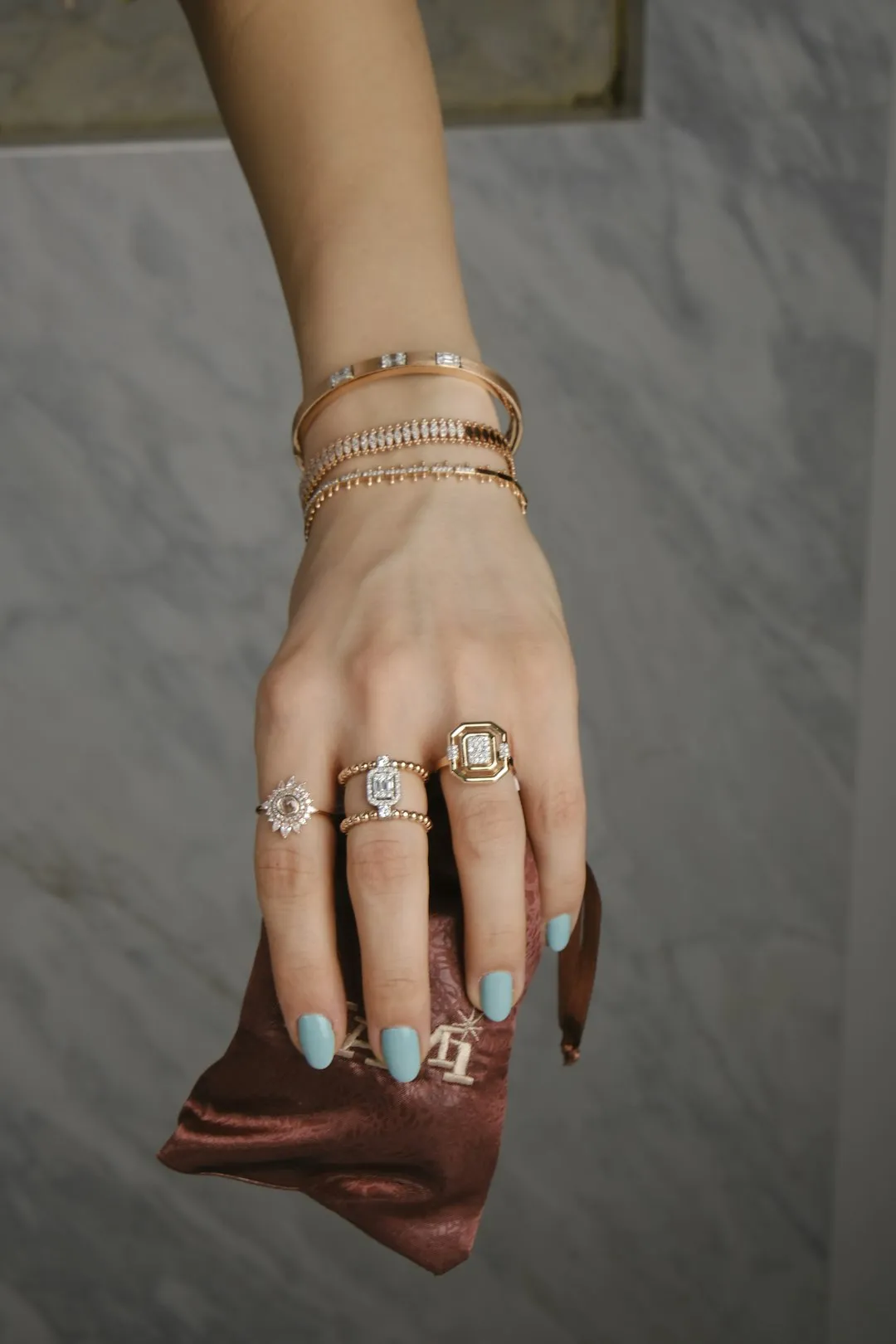
I'm Zak, founder of Quantum Qarat in Phoenix. Every week, clients bring me rings and bracelets stamped with small numbers and letters they cannot quite read, wondering what they mean. The stamps are easy to overlook, but they carry real information: the metal's purity, its origin, and in some cases its entire provenance. Understanding jewelry hallmarks is the first step toward knowing what you actually own, and what it is genuinely worth.
What Jewelry Hallmarks Actually Mean
Hallmarks are stamps pressed or engraved into precious metal jewelry to certify the metal's composition, often alongside information about the maker or the country of origin. They are the jewelry industry's system of accountability, and they have been in use in various forms for centuries. When someone brings me an unfamiliar piece, the hallmark is always the first thing I look for. It tells me more in two or three characters than a visual inspection can in ten minutes.
Beyond identification, these marks carry practical consequences. They affect what a piece is worth at resale, what an insurer will agree to cover, and whether an estate piece can be authenticated. A clear, honest hallmark is, in effect, the piece's permanent record.
The Most Common Jewelry Stamps, Explained
14K (or 585): The standard American marking for gold jewelry containing 58.3% pure gold, with the remainder being copper, silver, or other metals added for durability and workability. If you see "585," it is the European equivalent, representing the same gold content expressed as a decimal. For everyday jewelry that holds up well to regular wear while maintaining genuine value, 14K is the most practical choice in the market. The Heritage Auctions jewelry identification guide is an excellent reference for decoding maker's marks and metal stamps across different periods and origins.
925: The hallmark for sterling silver, indicating 92.5% pure silver alloyed with copper for strength. A "925" stamp means the piece is solid sterling, not plated. It is the international standard and appears on silver jewelry from virtually every producing country.
Gold-Filled (GF): A stamp such as "1/20 14K GF" means at least 5% of the piece's total weight is solid gold, bonded to a base metal core through heat and pressure. This is substantially more gold content than gold-plated jewelry, which carries only a thin electroplated surface layer and no meaningful gold value.
Hallmarks Around the World
In the United States, manufacturers typically apply hallmarks themselves without mandatory government verification. European systems are more formalized. In Britain, an independent assay office tests the metal and applies its own stamp alongside the maker's mark, recording the city of testing and sometimes the year. French pieces carry a system of guarantee stamps and maker's punch marks that can be traced through published records. In both traditions, small animal figures, alphabetic codes, and geometric symbols each carry specific meaning.
When a client brings in a ring stamped in Paris or London, the marks often tell a surprisingly complete story about when and where the piece was made. The Gemological Institute of America offers resources on authentication and identification methodology that are valuable context for anyone working with estate or international pieces.
Why Hallmarks Affect Value
Two rings with identical visual characteristics can carry meaningfully different values, and hallmarks are often why. A clear, period-accurate 18K stamp on an estate piece from a recognized maker supports a higher valuation than an unmarked or ambiguously stamped equivalent. Insurers require verified metal content before issuing coverage, and resale buyers, whether private collectors or estate dealers, use hallmarks as a first filter. If you are considering having a piece appraised or want to understand what a family heirloom is worth, a professional evaluation through our services team starts exactly with this kind of documentation.
Where to Look for Hallmarks on Your Jewelry
- Inside the shank of a ring, often near the bottom
- On the reverse side of pendant bails
- Near the clasp of a necklace or bracelet
- Inside the case back of a watch
- On the tongue of a bracelet clasp
On older pieces, stamps can be extremely small and may show wear that makes them difficult to read without magnification. A 10x jeweler's loupe reveals marks that are invisible to the unaided eye and is an inexpensive tool worth owning if you work with estate jewelry regularly.
Custom Jewelry and Hallmarks
When you commission a piece through our custom design process, the hallmark is part of the finished piece from the start. Every Quantum Qarat creation is stamped with its metal content, giving future owners, whether that is you a decade from now or the next generation, a permanent record of exactly what the piece contains. If you want to know the precise gold content or alloy composition of something we are making for you, we share that information as a matter of course.
Frequently Asked Questions
What does 14K mean on a ring?
It indicates the ring contains 58.3% pure gold by weight. The remaining 41.7% is typically copper, silver, or zinc, added to give the metal the hardness and workability that pure gold lacks.
Is 925-stamped jewelry high quality?
Yes. A 925 stamp certifies sterling silver, which is a durable and genuinely valuable material. It is the international quality standard for silver jewelry.
Can counterfeit pieces carry hallmarks?
They can, and some do. Counterfeit stamps are one reason why buying from reputable jewelers and seeking professional verification for high-value purchases matters. When in doubt, an XRF metal composition test will confirm or contradict what the stamp claims.
How do hallmarks affect resale or insurance?
Both insurers and buyers use hallmarks as a first step in establishing what a piece is worth. Clear, verifiable marks support stronger offers and make the documentation process significantly faster. For an expert assessment, book a private appointment and we can walk through any piece you bring in.
Do all precious metal pieces have hallmarks?
Most do, but not all. Antique handmade pieces, costume jewelry, and some older international pieces may carry no stamp or only a maker's mark without a metal purity indication. Absence of a hallmark does not necessarily mean a piece has no value, but it does mean verification requires other methods.
Start With the Mark
A hallmark is the most honest thing a piece of jewelry can tell you. Once you know where to look and what the common stamps mean, what seemed like decorative scratches becomes a legible record of the metal, the maker, and sometimes the century. For a broader grounding in precious metals and how composition affects both quality and value, our metals education guide is a useful next step.
If you have a piece you would like identified, or if you are ready to create something with its own hallmark built in, browse our fine jewelry collection or reach out directly. We are always glad to help.
A stamp tells you the metal, not the value
Hallmarks are a starting point. What a piece is actually worth depends on weight, stone quality, condition and craftsmanship — and on which kind of valuation you need, since insurance replacement value and resale value are very different numbers for the same item.
If a piece is unmarked, worn, or inherited without paperwork, bring it in. On older pieces the marks themselves often date the work, which matters for restoration as much as for valuation.
A stamp tells you the metal, not the value
Hallmarks are a starting point. What a piece is actually worth depends on weight, stone quality, condition and craftsmanship — and on which kind of valuation you need, since insurance replacement value and resale value are very different numbers for the same item.
If a piece is unmarked, worn, or inherited without paperwork, bring it in. On older pieces the marks themselves often date the work, which matters for restoration as much as for valuation.